Featured production · House of Worship
Alfred Street
Baptist Church.
Easter 2026.
A choir-centered production, built for the arena and online.
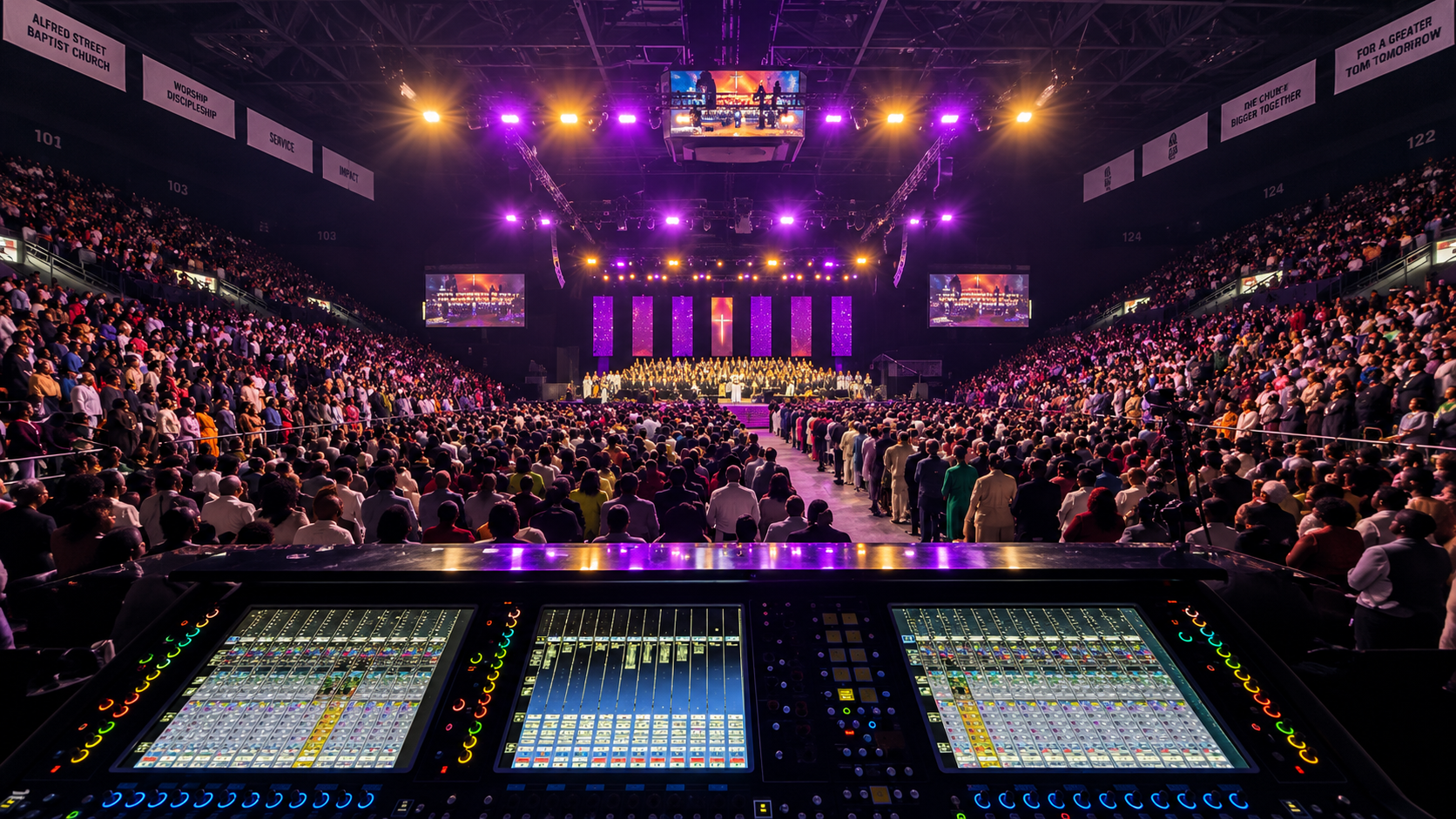
Approximately 175 choir voices, a praise team, orchestra, gospel band, and soloists. One musical production—with distinct listening experiences to consider in the arena and beyond it.
Marlon G. Daniel, Owner, Front of House Engineer
The brief
Clear. Coherent. Engaging.
For Alfred Street Baptist Church’s Easter 2026 production, MRD’s objective was to make a large musical ensemble clear, coherent, and engaging for both the congregation in the arena and the audience participating online.
MRD provided the sound system, audio engineering team, stage monitoring, RF coordination, broadcast audio, multitrack recording, and backline. Video production was delivered by CVW Events under subcontract to MRD Sound Productions.
MRD’s Easter production work with Alfred Street includes 2019, 2023, 2024, 2025, and 2026. This case study focuses on the 2026 scope and the decisions behind it.
01 / The musical approach
Build around the choir.
Alfred Street’s choir-centered musical identity shaped the approach from the outset. Personally mixing the arena sound, MRD owner Marlon G. Daniel established the choir’s presence, tonal balance, and level before building the other musical elements around it.
The central relationship was between the choir and the congregation, guided by the worship leader.
“I think it’s always good to determine your focal relationships before you start touching the console.”
Marlon G. Daniel, Owner, Front of House Engineer
The praise team added fullness and articulation. The band provided the musical foundation. The orchestra moved between supporting and featured roles as the arrangement required. Soloists sat within the musical picture, with room to step forward when appropriate—not permanently above it.
Microphone selection followed the same priorities. Marlon selected DPA 4011s for the choir for the natural presentation and off-axis character he wanted, and DPA 4099s for the individual orchestral instruments. Across the stage, microphones were selected source by source rather than around a single-brand package.
02 / The online audience
A dedicated mix.
A separate finishing stage.
Four consoles shared an Optocore loop, with the broadcast console in a separate room. One engineer concentrated on the broadcast mix. A second handled downstream mastering and finishing, attending to final tonal balance and level consistency across the program.
That division allowed the broadcast mixer to focus on the musical relationships while another engineer considered the finished presentation reaching the listener.
Listening on the audience’s terms.
The finishing engineer checked both the direct program feed and the actual livestream returning from the viewing platform. A phone, laptop, and ordinary consumer headphones—including inexpensive models—kept everyday playback conditions part of those decisions.
MRD also provided multitrack recording alongside the arena and broadcast mixes.
03 / The musicians
Give the orchestra its own engineer.
For 2026, MRD added a monitor engineer specifically responsible for the orchestral ensemble. Previous experience had shown that the orchestra needed more focused attention than one engineer covering the entire stage could provide.
A separate monitor engineer handled the praise team, choir fills, and stage wedges. The orchestra had someone dedicated to helping its players establish comfortable, natural-sounding in-ear mixes. Marlon reports that the musicians responded positively to that specialized attention.

The band used Allen & Heath ME-1 personal mixers, giving its members control over their own listening balance.
04 / Wireless & communications
Dedicated RF coordination.
MRD assigned a dedicated RF technician to coordinate the production's wireless microphones, wireless in-ear monitors, and Clear-Com FreeSpeak communications.
- Wireless microphone channels
- 26
- Wireless IEM channels
- 16
- Clear-Com FreeSpeak drops
- 15
05 / The preparation
Each Easter informed the next.
Before the full ensemble rehearsed, MRD had already line-checked the instruments and roughed in baseline mixes on the band’s ME-1 units. Musicians could start with an established mix and refine it, rather than build from zero.
Across the recurring Easter productions, Marlon reviewed console preparation, show-file programming, routing, staffing levels, and specialist assignments. Established production concepts carried forward, but the process was refined rather than simply repeated.
The additional orchestra monitor engineer was one concrete result: a staffing decision informed by the demands of the production and the attention the musicians needed.
06 / The audience response
Positive feedback from both audiences.
Following the service, MRD received positive feedback about both the arena sound and the online presentation. Marlon also reported appreciative comments from participants watching the livestream.
That reported response addressed the production’s central objective: support the musical experience in the room while giving the online audience its own carefully considered presentation.
The team behind the production
Production credits
- Audio production, stage monitoring, RF coordination, broadcast audio, multitrack recording & backline
- MRD Sound Productions, LLC
- Owner, Front of House Engineer
- Marlon G. Daniel
- Video production
- CVW Events
Under subcontract to MRD Sound Productions